China buying agents, explained from the warehouse door outward
An agent buys for you inside China, holds the goods in its warehouse and sends them abroad on the line you choose. Here is what that involves.
What a China buying agent does for you
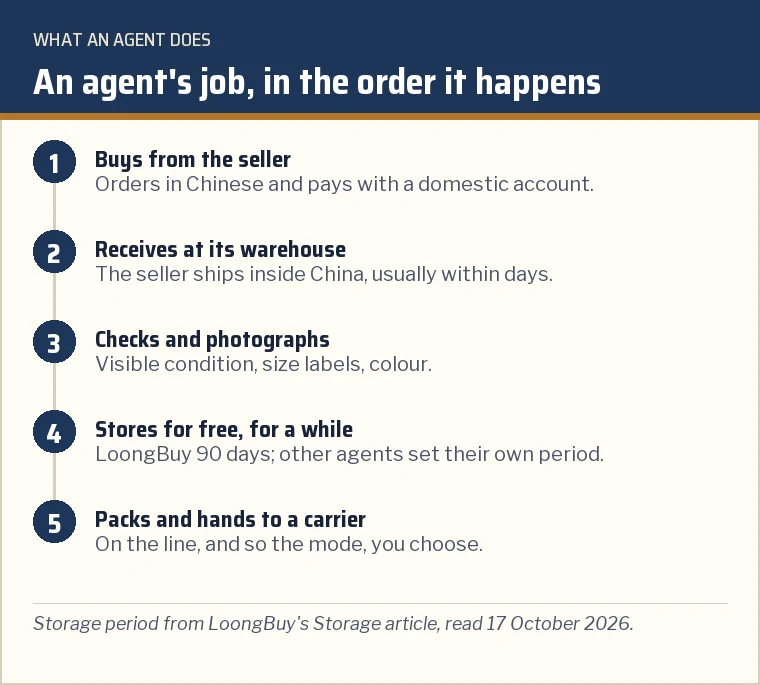
A China buying agent is a company that buys on your behalf from Chinese marketplaces that will not sell or ship to you directly. You copy a Taobao, Weidian or 1688 link into the agent's site and cover the item plus the seller's postage inside China. The agent places the order in Chinese, pays the seller, and has the item delivered to its own warehouse inside China.
At the warehouse the item is unpacked, checked against the order and photographed, then stored free for a set period, often 90 days. Kakobuy allows 100 days, the longest of the six agents featured here by an independent October 2026 measurement. When you are ready, you choose which stored items go together, the agent packs them into one parcel, and you pay the international freight for the line you pick.
Everything up to that point is about buying. The last step is about freight, and it is the step where agents differ most in what they write down.
Follow a shirt and a pair of shoes through the two payments
You find each product in a different shop and submit two precise buying requests. The first payment covers the goods and relevant domestic purchase charges. The sellers deliver to the agent’s warehouse, possibly on different days. Inspect each arrival promptly instead of waiting for the whole basket; an early item can reach its return deadline while a later one is still being prepared.
Once the goods are acceptable, decide whether they should share a parcel. Keeping the shoe box adds protection and volume. Removing it can change return options. Compare the combined and separate arrangements with the same destination and service needs, then choose an eligible route. This is the second payment: international freight and selected parcel services, with other applicable payment or destination costs included in the full budget.
Compare agents such as LoongBuy and the other services described here using that same basket and set of questions. Ask about link acceptance, useful QC, packaging, route restrictions, support and remedies. A low buying commission or an advertised transport mode is only one part of the decision. Direct shipping or a local purchase may be simpler when it already provides the delivery and return terms you need.
The parts of the job that touch freight
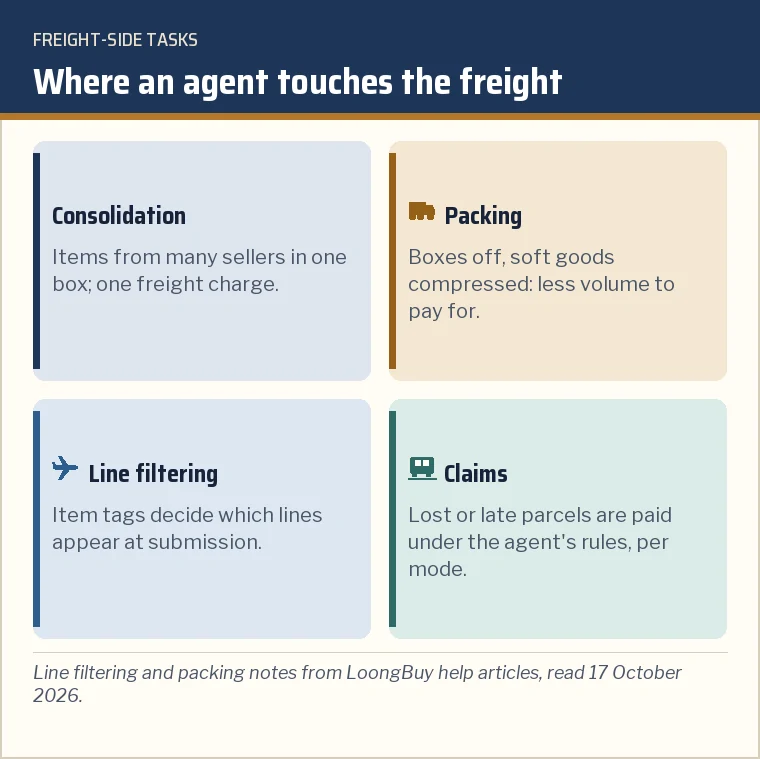
Four of an agent's tasks shape the freight outcome. The first is consolidation: putting items from several sellers into one box, which is usually cheaper than sending them one by one. The second is packing, where removing shoe boxes or vacuum-sealing soft goods changes the volume the carrier charges for. Agents sell these as optional parcel services and warn that they change the final weight.
The third is line filtering. LoongBuy, for instance, tags each item after its warehouse check by category, material and form, and when you submit a parcel it only shows the lines that accept every tag inside it. A single battery-powered item can take most air lines off the menu.
The fourth is claims and special requests. When a parcel is lost or late, the agent deals with the carrier and pays out under its own written rules, which differ by mode, and some agents, Superbuy and Oopbuy among them, also take requests for custom rail or sea routes. That is the reason this site reads agents by mode at all.
Why use a buying agent instead of ordering direct
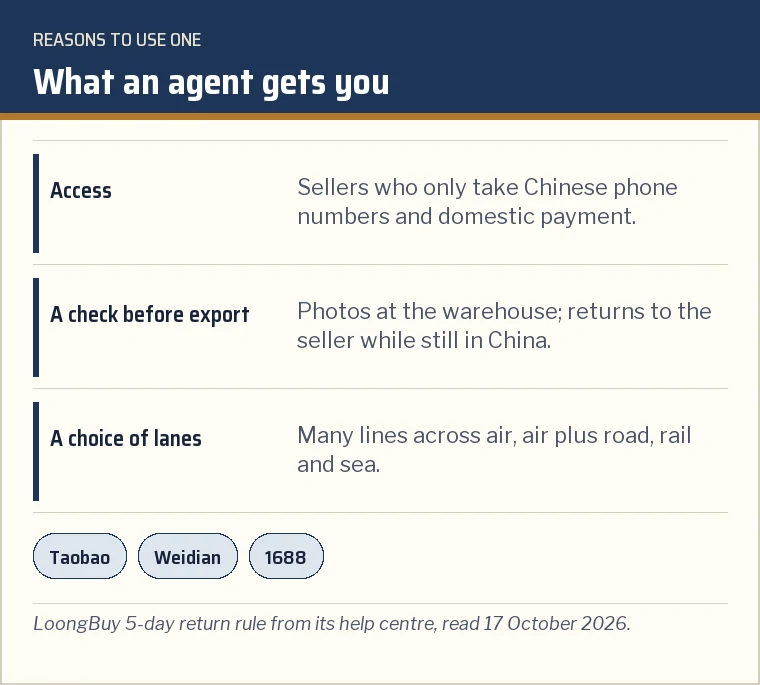
The plain reason is access. Most sellers on Taobao, Weidian and 1688 serve customers inside China only: the checkout wants a Chinese phone number and a domestic payment method, product pages are in Chinese, and the seller will not post abroad. An agent removes all three obstacles at once.
The second reason is the warehouse. Items from different sellers wait in one place, you see photos before anything crosses a border, and a wrong size can usually go back to the seller while it is still in China. LoongBuy's 5-day return rule, for example, runs from the day an item reaches its warehouse. Once a parcel has left the country, returning one item to a Chinese seller is rarely worth the freight.
The third is freight choice. A seller who does post abroad usually offers one way to do it. An agent offers many lines across several modes, which lets you trade time against money and risk, and choose the rules you can live with.
When you should not use an agent
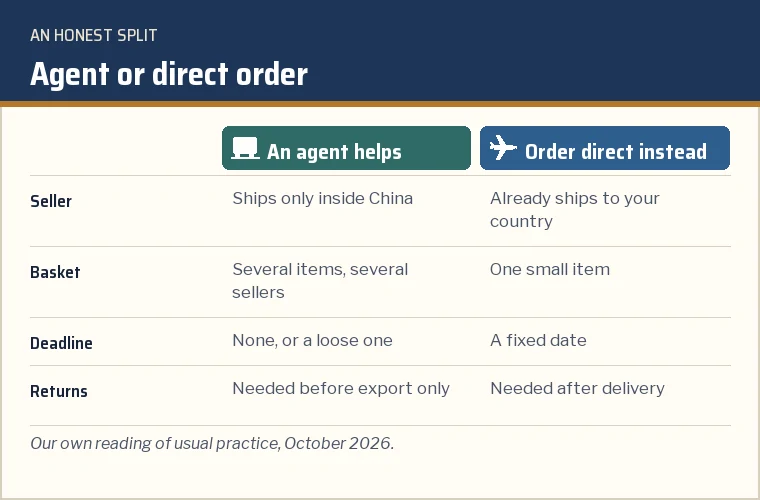
An agent is not always the better route. If the same item is sold by a seller who already ships to your country, with a local returns process and tax collected at checkout, a direct order is usually simpler, and for a single small item it is often cheaper once international freight is counted.
An agent is also a poor fit when a delivery date is fixed. Between the seller's domestic delivery, the warehouse check, packing and the international lane, an agent order takes longer than a direct one even on air express, and the slow lanes add weeks. And if you need to return items after they arrive, an agent order is the wrong tool: returns are practical only before the parcel leaves China.
Where an agent clearly helps is the opposite case: several items from sellers who do not ship abroad, a buyer willing to look at photos before export, and enough time to pick a lane on the rules rather than on panic.