
Freight modes out of China, and the rules each of them changes
Five ways a parcel can leave an agent warehouse, read against the rules agents write for each one, with a card that compares any two.
Plane, truck, train or ship
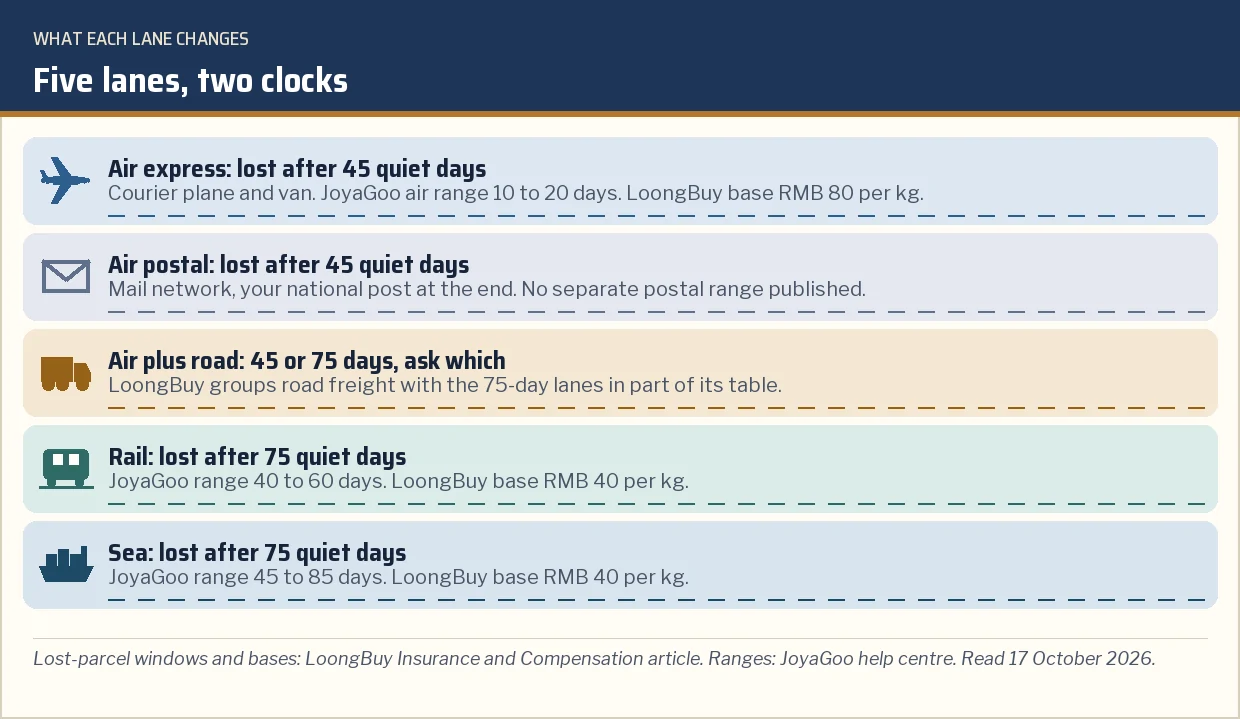
Strip away the brand names agents give their shipping lines and a parcel leaving a Chinese warehouse goes one of five ways. It flies with a courier. It flies as international mail. It flies into Europe and finishes on a truck. It rides a freight train. Or it sails in a container. Agents list dozens of lines, often more than a hundred, but many can be understood through these broad transport groups.
The lane matters for more than the price on the line card. In LoongBuy's insurance and compensation table, an air or express parcel may be treated as lost after 45 days without a carrier scan, while sea, rail and the road or chartered-air group get 75 days. The compensation base halves between the two groups, from RMB 80 to RMB 40 per kilogram of parcel weight. Fansbuy's delay refund, set out in its insurance and compensation article, simply does not apply to rail or sea freight.
Those differences are written down, which makes them comparable. That is what this page does: one section per lane, a card that compares any two, and links to the agent pages each rule comes from.
The mode-pair card
Choose any two of the five modes. The card lines up the same eight points for both: how the parcel moves, the time range agents print, when silence turns into a lost parcel, the compensation base, delay compensation, what usually stays off the lane, where customs usually happens, and how you book it.
Add an agent and its own published wording appears in bold above the general note. The card never asks for a weight, a destination or a price, and it does not name shipping lines or put agents in order; those belong to the agent's own checkout, on the day you ship.
Times and rules come from agent pages read on 17 October 2026. Usual practice is marked as such; the line card at checkout is what binds.
Air express and air postal, the default lanes
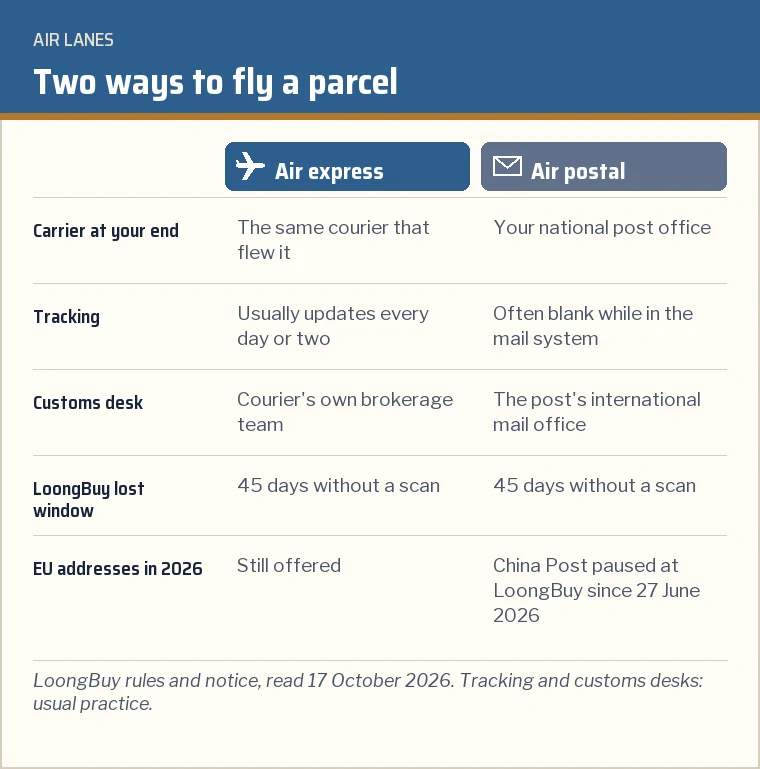
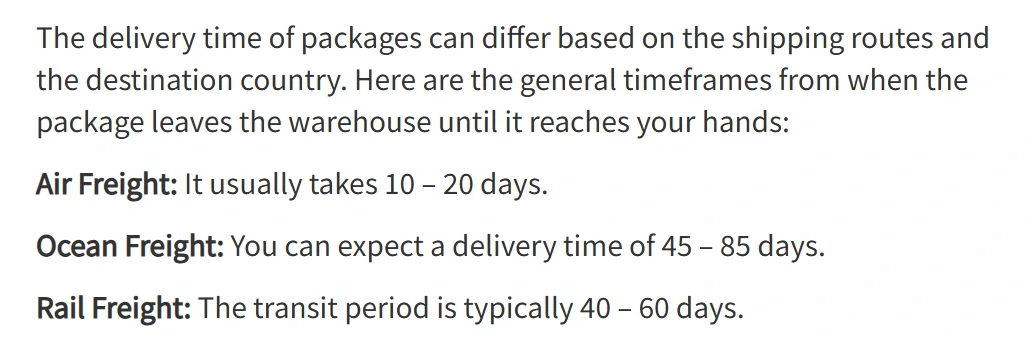
Most agent parcels fly. An express line hands the box to a courier that runs its own aircraft or buys cargo space, and the same courier's van brings it to your door, so there are few handovers and the tracking usually updates every day or two. JoyaGoo gives air freight in general as 10 to 20 days counting from the day the parcel leaves the warehouse, and express lines usually land at the shorter end of that.
A postal line flies the parcel as international mail and passes it to your national post office for the last stretch. The receiving post sets the pace there, and its tracking can go blank for days while the item waits in a sorting office. For EU addresses this lane narrowed sharply in 2026: LoongBuy's notice dated 27 June 2026 paused China Post shipping to every one of the 27 member states, and on 17 October 2026 its notice list still showed no restart.
Both air lanes sit in the same group in LoongBuy's rules: 45 days of carrier silence before a parcel may count as lost, and RMB 80 per kilogram of parcel weight as the compensation base if it is.
The road leg inside many air lines
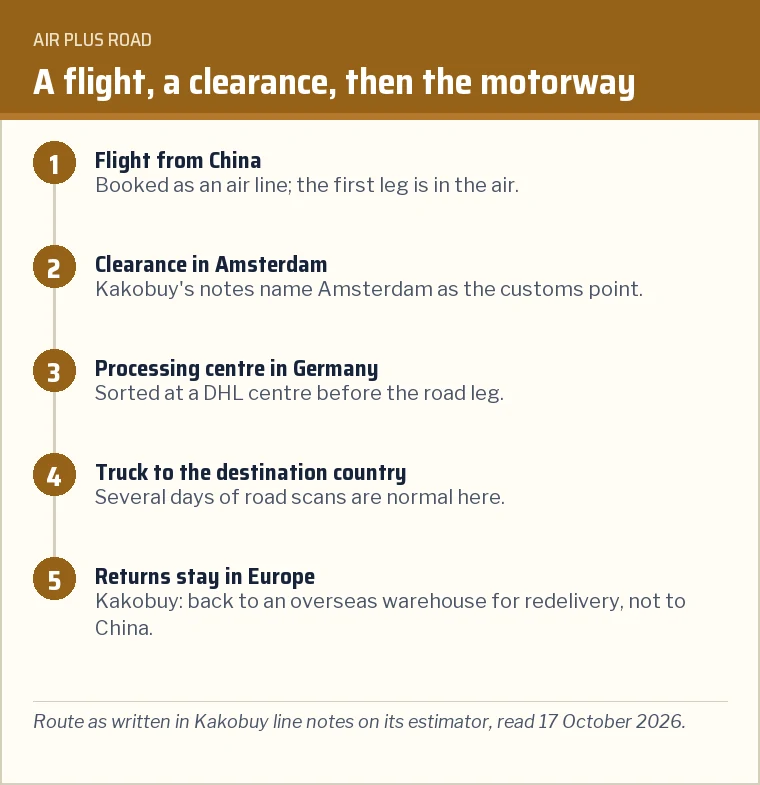
Plenty of lines sold for Europe are not air all the way. The parcel flies to an airport in one country, usually the Netherlands, Belgium or Germany, clears customs there, and then rides a truck to its destination. That is why a parcel booked on an air line often shows several days of road scans near the end of its tracking.
Kakobuy writes this out in its Europe line notes on the shipping fee estimation page: the package is carried first to Amsterdam for customs clearance, then to a DHL processing centre in Germany, and then by truck to other European countries. The same notes ask for an address detailed to the house number and say these parcels can only go back to an overseas warehouse for redelivery, never to China. On CNshopper's freight estimator for a 1 kg parcel to Germany, lines with a lorry leg listed 20 to 28 and 20 to 35 days against 7 to 15 days for the air lines (our own check, 17 October 2026).
For the rules, ask which group the line belongs to. LoongBuy places road freight with sea and rail in two rows of its table, at 75 days and RMB 40 per kilogram, so a line described as road can carry the slower clock.
Rail parcels and the long silence between scans
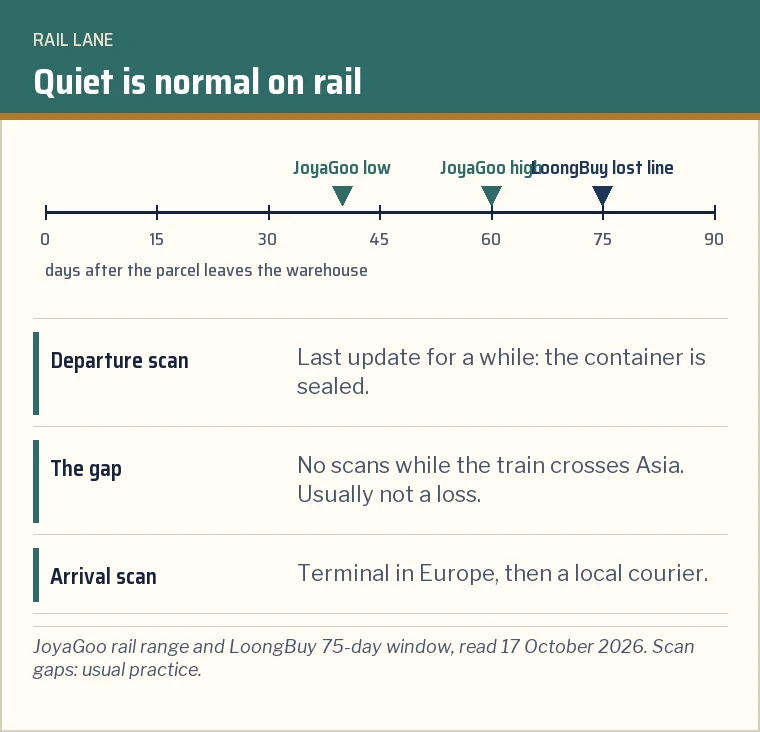
Rail parcels travel in containers on freight trains that cross Central Asia into Europe. Between the departure scan in China and the arrival scan at a terminal in Europe there may be nothing at all for weeks, because nobody scans a parcel sealed inside a moving container. To a buyer refreshing the tracking page, that silence looks exactly like a lost parcel. Usually it is not.
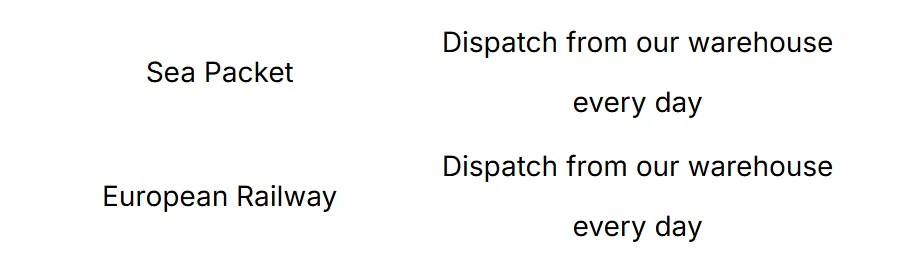
Agents set their rules with that in mind. LoongBuy gives sea, rail and chartered-air parcels 75 days without a carrier scan before they may count as lost, against 45 for air. JoyaGoo prints rail at typically 40 to 60 days after the parcel leaves the warehouse, and CNshopper's railway option to Germany showed 35 to 50 days when we looked on 17 October 2026 (our own check). Lovegobuy lists a European Railway line that is dispatched from its warehouse every day.
In practice, rail suits a large haul you are not in a hurry for. It is rarely worth it for a light parcel, and it is the lane where patience, not a support ticket, solves most worries.
Sea freight for hauls that can wait
Sea is the slowest lane and the one with the most room. A container ship carries the parcel to a port near you, where it is unloaded and cleared, and then a courier takes it on. JoyaGoo prints ocean freight at 45 to 85 days after the parcel leaves the warehouse, the widest range of the five.
Some agents treat sea as a special arrangement rather than a line you click. CSSBuy's shipping methods article says that large, heavy items can be shipped by sea to your nearest port and asks you to contact it for this service, so read the offer closely: a port delivery may require separate clearance and onward transport. Lovegobuy, by contrast, lists a Sea Packet line dispatched from its warehouse every day.
The rules follow the rail pattern. LoongBuy waits 75 days of carrier silence and pays RMB 40 per kilogram for a lost sea parcel, and Fansbuy leaves sea freight out of its delay refund. Seasonal backlogs at ports add to the wait in the busiest months.
A daily departure is not a daily arrival
Lovegobuy's parcel dispatch schedule is a useful reminder of where the slow part of a slow lane happens. Its European Railway and Sea Packet lines are both marked as dispatched from the warehouse every day, which means a packed parcel does not sit waiting for a weekly train or ship at the agent's end. The weeks are spent later, in the container.
The schedule is labelled as for reference only, with the carrier's own arrangement taking precedence, and pickups pause on weekends and public holidays on many of the other lines. So the first few days after you submit a parcel tell you little about the mode. What matters is the time from the departure scan, which is also where LoongBuy starts its 45 and 75-day windows.
Seasons and holidays slow every lane
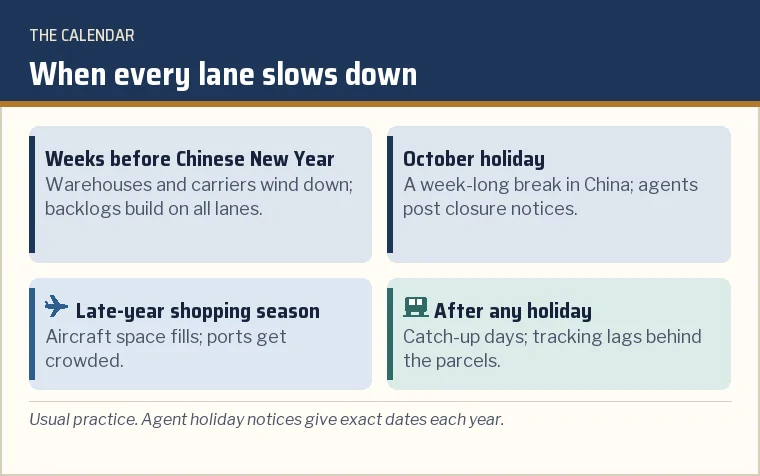
No lane is immune to the calendar. In usual practice the weeks before Chinese New Year and the October holiday clog warehouses and carriers alike, and the late-year shopping season fills aircraft and ports. A parcel that would take two weeks by air in spring can take noticeably longer in December, and the slow lanes stretch further still.
Agents publish their own holiday notices; LoongBuy, for example, posted one for the National Day break on 23 September 2026. The practical rule is to submit early when a date matters, and to choose air when it matters a lot. Rail and sea are for hauls with no deadline at all.