Risk signals with China buying agents, including the parcel that goes quiet
Most worries on a slow lane are silence, not loss. This page shows where the line falls, and which signs point to a real problem.
When a slow parcel officially counts as lost
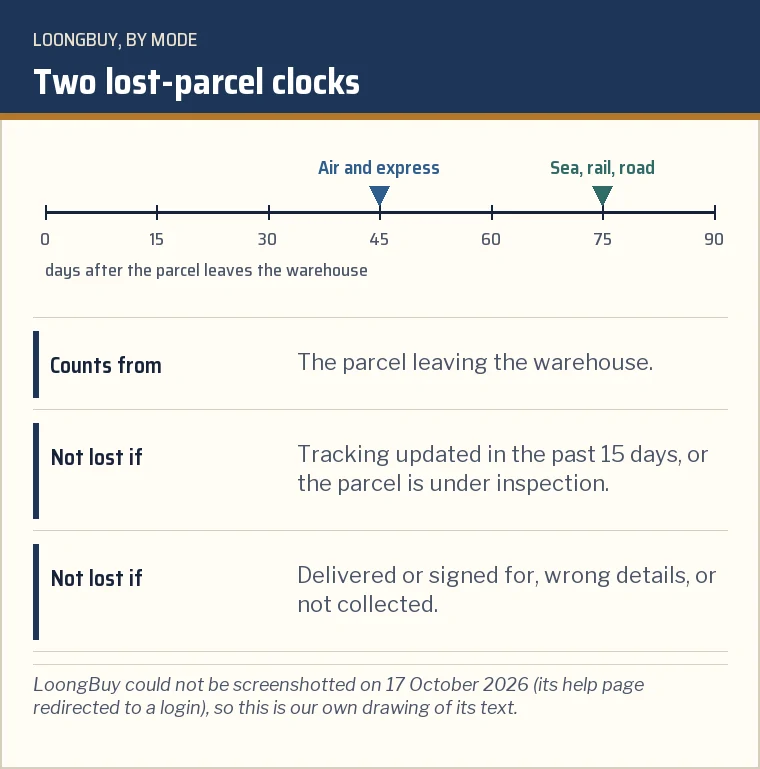
Agents do not call a parcel lost the moment tracking stops. They wait for a written number of days without a carrier scan, and that number depends on the mode. LoongBuy's insurance and compensation table gives 45 days for air and express parcels and 75 days for sea, rail and the road or chartered-air group, counted from the parcel leaving the warehouse. Until then, the parcel is late, not lost. Fansbuy sets a different line for delay on insured parcels, 60 days, and leaves rail and sea out of it.
The same table lists exceptions that stop a parcel from counting as lost at all: wrong recipient details, a parcel you failed to collect, tracking that shows it signed for or delivered, tracking that is still updating with the latest scan inside the past 15 days, and a parcel under customs or other official inspection. A parcel held by customs is a separate case, and LoongBuy pays nothing for it without paid cover.
Write your own date down when the parcel leaves. On day 46 of an air parcel, or day 76 of a rail one, you have a claim worth raising.
Silence on a slow lane, or a parcel really gone
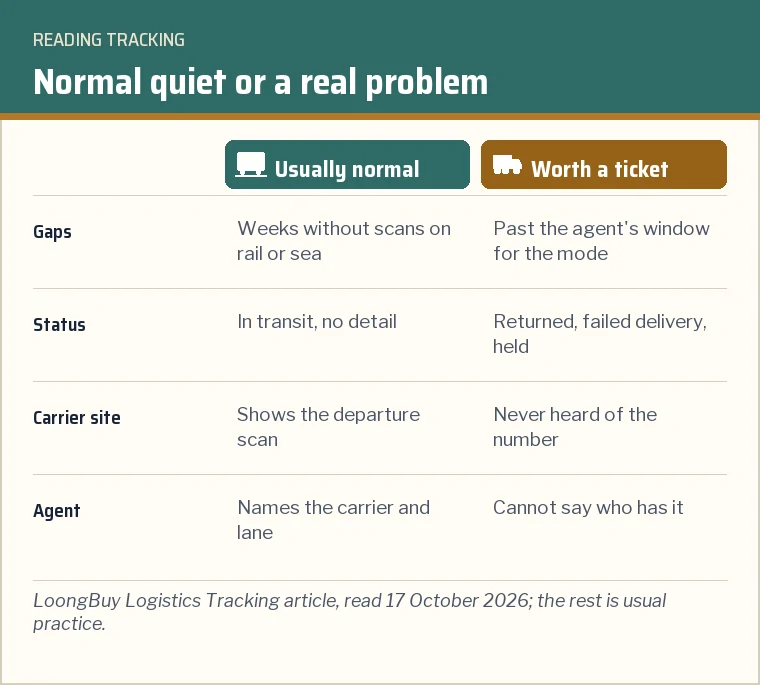
On rail and sea, long gaps between scans are normal: a parcel sealed in a container is not scanned while it travels. LoongBuy's own tracking article says that international parcels pass through several transport stages and that periods with no new record are generally normal. So the first signal to read is the lane, not the silence.
Signs that point to a real problem are different. A parcel that has passed the agent's window for its mode. Tracking that shows a return to sender, a failed delivery or a customs hold you did not hear about. A carrier site that has never heard of the tracking number weeks after dispatch. Or an agent that cannot tell you which carrier holds the parcel.
If none of those apply, waiting is usually the right move. If one does, open a ticket with the agent and keep screenshots of the tracking, because claims run on the agent's evidence of what the carrier said.
Agents that sit on orders or disappear
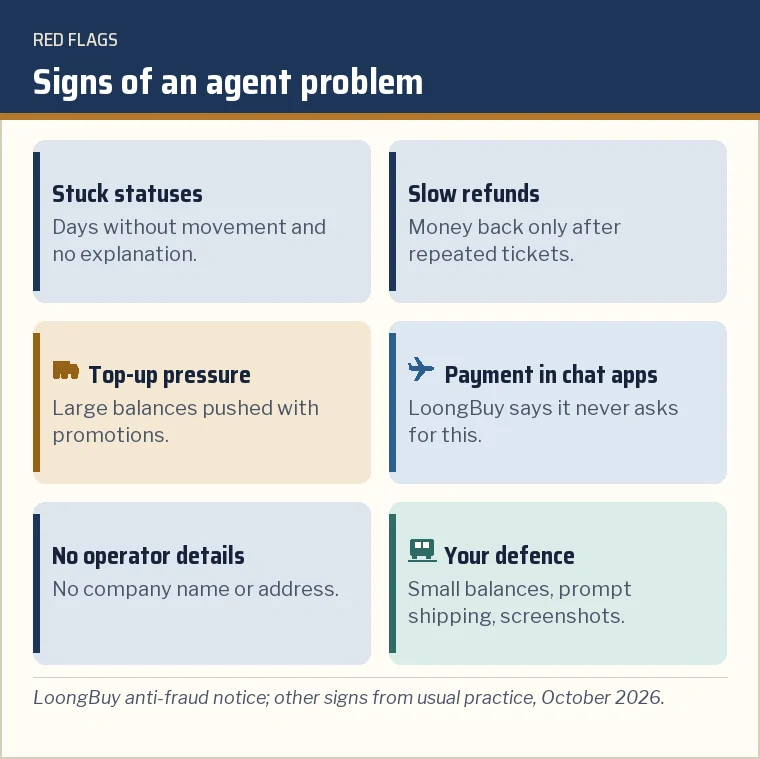
The rarer and more serious risks have nothing to do with freight. Some agents have been known to eat orders: they take payment and the order status never moves, the purchase is never placed, or a refund for a cancelled item never reaches your balance. Others have closed with little notice, leaving balances and stored goods in limbo. Neither is common among established agents, but both happen.
The warning signs are plain. Order statuses that sit unchanged for days without an explanation. Refunds that arrive only after repeated tickets. Pressure to top up large balances for a promotion. Payment requests through chat apps instead of the agent's own checkout; LoongBuy's anti-fraud notice says it never asks for extra payment through WhatsApp or social platforms. No company name or address anywhere on the site.
The defence is just as plain: top up only what the next order needs, withdraw unused balances, and ship stored items well inside the free period.
Refused, held or returned parcels
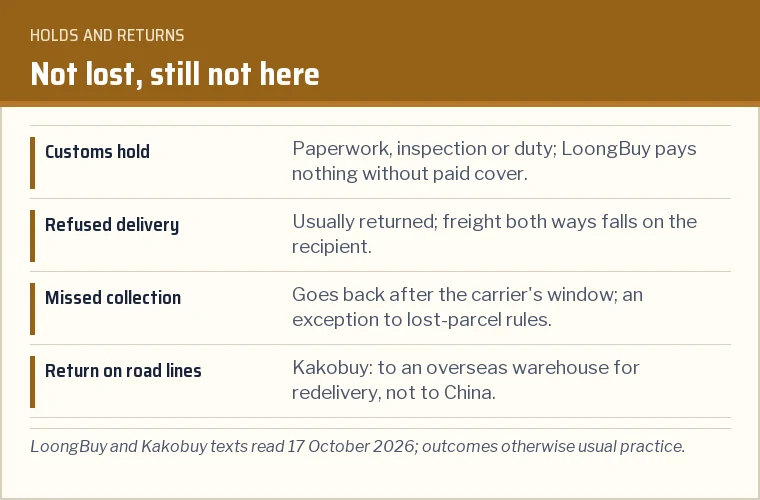
Some parcels never reach the door for reasons that are not loss. Customs may hold a parcel for paperwork or inspection, ask the recipient for an invoice, charge duty or tax, or refuse it. A recipient may refuse a delivery, or miss a collection window so the parcel goes back. Each mode handles the aftermath differently.
On the air plus road lines Kakobuy describes, a returned parcel can only go back to an overseas warehouse for redelivery, never to China. On every lane, a parcel that bounces adds freight and time, and agents generally charge the recipient for both. Compensation tables usually exclude customs detention unless paid cover was bought, and treat a parcel the customer failed to collect as an exception to the lost-parcel rule.
Two habits prevent most of this. Give a full address with a house number and a reachable phone number, which Kakobuy's notes require on its Europe lines. And read the line notes before you choose: they often say who pays duty and where returns go.